
Financial markets have always moved in cycles. Periods of optimism and growth—known as bull markets—are followed by periods of decline and caution, called bear markets. Understanding these cycles can help investors stay grounded during times of uncertainty and avoid emotional decision-making when headlines turn negative.
Historically, bull markets last far longer than bear markets.
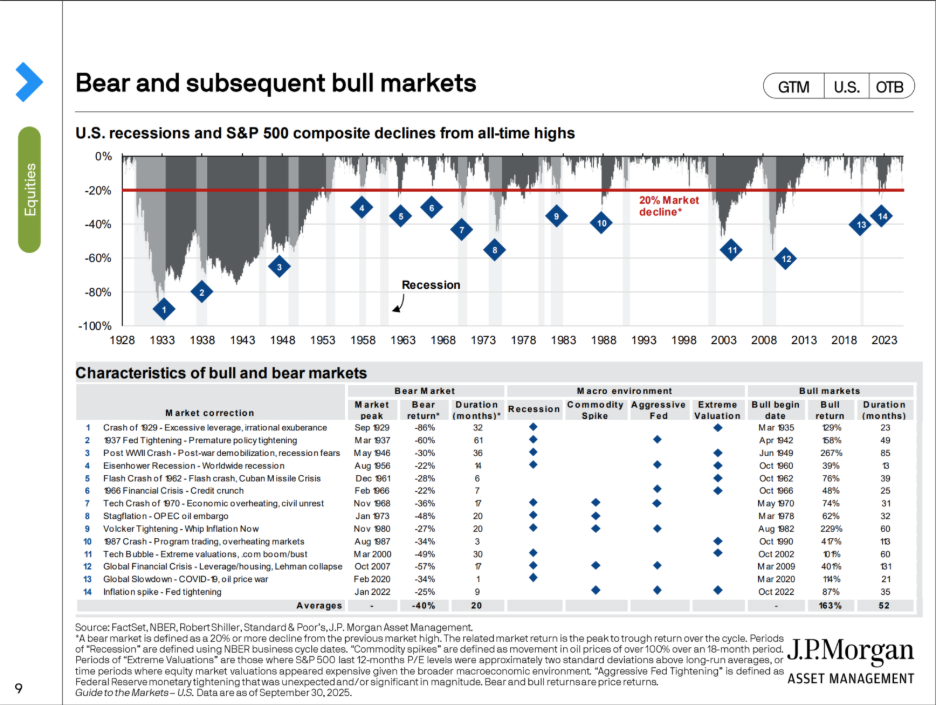
Since World War II, the average bull market in the U.S. has lasted 52 months, producing gains of roughly 163% on average. In contrast, bear markets typically lasted 20 months, with average declines of 40%. While bear markets can feel painful in the moment, history shows they are usually shorter-lived interruptions within a longer-term upward trend.
In today’s blog, we explore where we are today, Bull, Bear, or Market Correction. Let’s get started.
Bulls, Bears, and Market Corrections; Oh My!
When talking about bull and bear markets, there is often confusion with market corrections as well. Market corrections—declines of 10% or more—are even more common and are not the same as full bear markets.
On average, the S&P 500 experiences a correction roughly once every 18–24 months.
These pullbacks are a normal part of market behavior and often occur without triggering a recession. In fact, many strong bull markets include several corrections along the way.
We have experienced 3 pullbacks of 10% or more in just the last 5 years in the S&P 500.
How the Markets Change
What ultimately drives the transition from bear to bull markets is not headlines, sentiment, or short-term volatility—but fundamentals.
Economic growth, corporate earnings, interest rate trends, and inflation expectations all play a role. Historically, markets often begin recovering before economic data looks healthy, which is why waiting for “all clear” signals can mean missing a meaningful portion of the recovery.
So where do we stand today?
We have experienced two bear markets in the past 5 years, although both were very short lived. The pandemic-driven bear market in February of 2020 was significant (-34% drop in the S&P 500), but all of that downside came in 1 month, and the market had recovered by June. January of 2022 saw a 25% drop in the S&P, and lasted a little longer, taking 9 months to go from peak to floor, but the market has recovered well, up 87% since October of 2022, which signaled the start of the current bull market we find ourselves in today.
As we start to read more headlines about concerns in the economy and the market continuing to hit all time highs, it could lead us to conclude that the market is ‘due’ for a pullback or bear market.
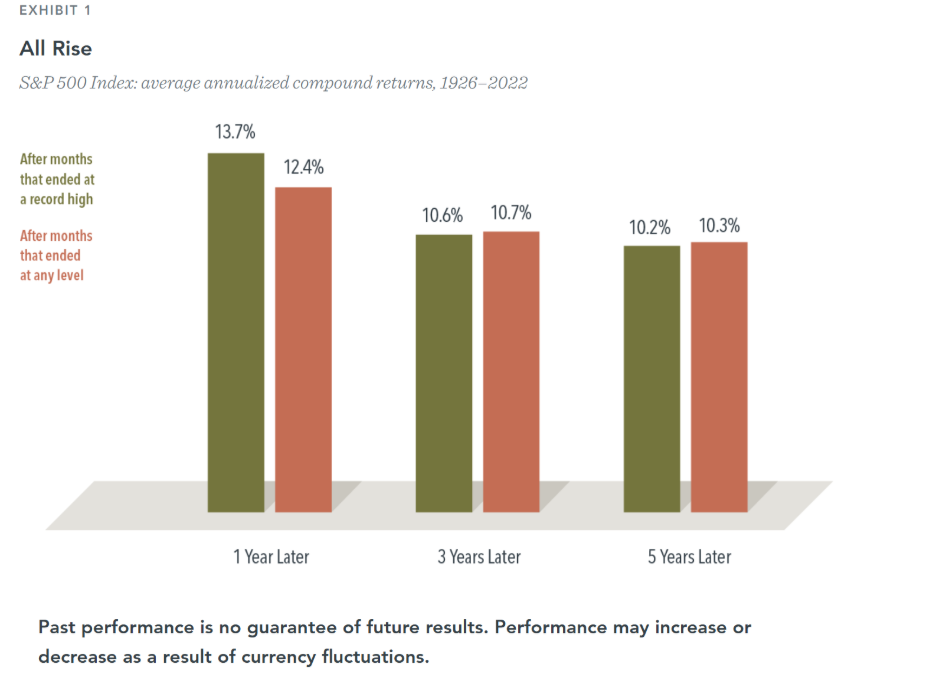
However, history shows us that these cycles are unpredictable, and that many times, bull markets can run for quite some time.
In fact, the chart below shows how markets behave after hitting an all-time high:
Your Partner in Every Market
At Master’s Wealth Management, we believe successful investing requires discipline and patience, all driven by your personal financial plan and goals.
By focusing on diversification, long-term goals, and proper asset allocation, investors can navigate both bull and bear markets with confidence—knowing that cycles may change, but sound strategy endures. If you have questions after reading this blog, or would like to discuss your unique situation, please reach out to us.